
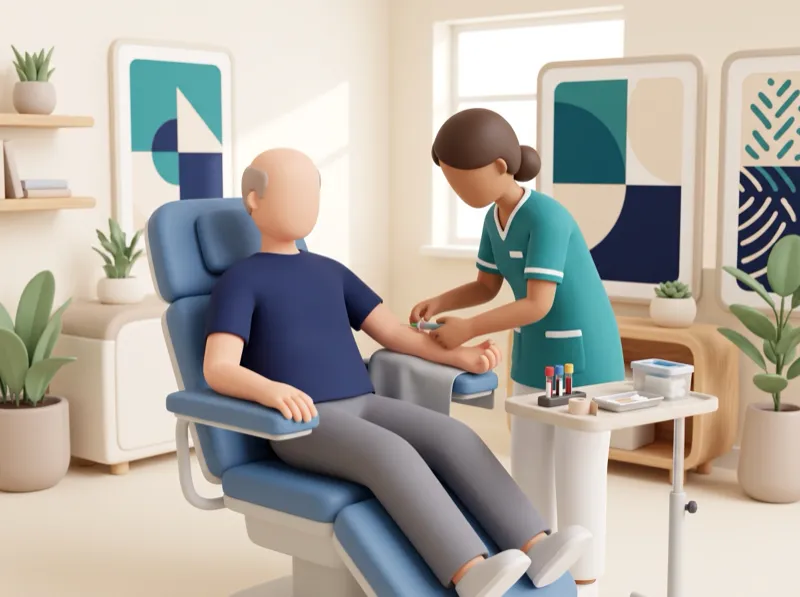
1A routine visit
An adult has the routine blood work their care already calls for. No new test is needed to generate the flag.
Health Systems
Turn routine lab results already on file into a prioritized list for kidney evaluation. NephroSense AI helps clinicians decide who needs confirmatory eGFR and urine albumin testing next.
01
Routine labs
Already on file
02
Clinician review
Priority for kidney evaluation
03
Confirmatory testing
eGFR + urine albumin
Physician oversight at every step
The scale of the gap
87%
37MUS adults with CKD
SourcesThe Gap in the Record
One patient, one draw, read two ways. Nothing on either side was ordered specially — the difference is which values get read together.
Today
Each result read on its own, and the one the record never received.
Routine results — unremarkable, one at a time
Urine albumin (uACR) — not ordered
No flag raised
Nobody decided this patient does not have CKD. Nobody looked.
Read together
The same values already on file, entered or uploaded into NephroSense AI.
Prioritize — confirmatory kidney evaluation
Suggested next step: eGFR + urine albumin (uACR)
One Patient's Journey
What the workflow looks like for one person, with the clinician deciding at every step.
1A routine visit
An adult has the routine blood work their care already calls for. No new test is needed to generate the flag.

2Flagged for review
NephroSense reads the labs already on file and flags this patient for the clinician, with a confidence signal.

3Confirmatory testing
The clinician reviews the flag and decides whether to order the eGFR and urine albumin tests that confirm or rule out kidney disease.

4Follow-up is planned
The results come back to the clinician, who plans the follow-up. Every diagnosis and treatment decision stays with the care team.
Illustrative journey. The people shown are illustrations, not real patients, and the steps describe the clinical workflow, not a study result.
For Health Systems
A flag is only worth what happens after it. These are the outcomes a deployment is evaluated against.
Of those flagged, how many received the eGFR and urine albumin testing KDIGO recommends.
How many flagged patients were confirmed on follow-up — whether the flag is worth acting on.
Whether patients needing nephrology or care-management follow-up actually reached it.
Review time per flagged patient, and whether the flag arrives inside an existing workflow.
Solutions
Risk triage runs today, beside the chart. The EHR integration puts the same output inside it, and is in development. Different buyers, and each carries the stage it has reached.
CKD risk triage from the panel you already drew
The primary workflow reads a routine adult workup — blood work and vitals already recorded in ordinary care — and returns a CKD risk score with KDIGO-aligned clinical considerations in under ten seconds. No additional screening order, no new hardware. The output is a prioritization: which patients should move to the front of the queue for the confirmatory eGFR and urine albumin testing KDIGO already recommends.
Where this stops: NephroSense AI is Clinical Decision Support, not a diagnostic. It does not replace urine testing, eGFR or any other test, and it does not diagnose CKD. Confirmatory kidney testing is ordered by the clinician after a patient is flagged, and every clinical decision remains the provider's, based on a complete patient evaluation.
Generated Report
CKD Risk Assessment Report
Synthetic patient · Generated Mar 15, 2026
Illustrative — synthetic data. Not a real patient or a performance claim.
Clinicians, primary care groups, FQHCs
The same output, inside the chart instead of beside it
Risk triage runs alongside the chart; the EHR integration would run inside it. It is the embedded layer, returning structured risk into the record and following what happens after a patient is flagged. That integration work is underway now.
What has to be true first: A first site. The engineering is in progress; what it needs alongside that is an institution willing to co-design the workflow placement and do the interface and governance work any EHR integration requires there.
Scope: The integration changes where the output lands, not what the model does or what it is permitted to claim. Until it ships, risk triage reaches clinicians through the standalone workflow and the FHIR R4-shaped output it already emits.
Order Set
DraftPatient flagged for kidney evaluation
Confirmatory Tests
Referral, if indicated
Configurable to your standard of care
Illustrative — synthetic data. Not a real patient or a performance claim.
CMIO, clinical informatics, IT
Evidence
Stated plainly, because you should not have to ask for it.
Retrospective feasibility demonstrated on a US adult clinical cohort. Retrospective external testing on an independent US cohort is complete; the result is company-reported, unpublished and not yet peer reviewed.
NephroSense AI is a Clinical Decision Support tool for use by licensed healthcare professionals with physician oversight. It does not provide medical diagnoses and does not replace any laboratory or diagnostic tests. By integrating a patient's existing clinical data faster, it helps clinicians prioritize who needs confirmatory testing and follow-up sooner. All clinical decisions must be made by qualified healthcare providers based on a complete patient evaluation.
One Platform
Health systems and trial sponsors ask different questions. Each application requires its own model and its own validation, but all of them are built on one platform: the same routine-panel inputs, the same deployment architecture, the same IP.
The model reads values already present in a routine adult workup — drawn and paid for as part of ordinary care. No new assay, no new visit, no new hardware.
Institutional deployments are designed so that inference runs inside your environment as a query-only container — patient-level data does not leave it, and the model is not transferred to you as weights.
Your environment
Your records
Values already on file
Query-only container
Inference runs here
Your team
Receives the output
Patent-pending technology. Provisional patent filed March 2026.
Getting Started
Nothing here requires a commitment to the next thing. The first one does not require talking to us at all.
Open the demo application and put your own values through it. Nothing to install, no conversation required.
What it settlesWhether the output is something your clinicians would act on.
We run the model against a de-identified extract of your own patients and report what it would have surfaced, against what actually happened.
What it settlesWhether the signal is there in your population, before any deployment.
A defined cohort, a defined workflow placement, and the outcome measures above agreed in advance.
What it settlesWhether it changes confirmatory-testing and referral completion in practice.
Before procurement asks
FAQ
A retrospective look-back reports what the model would have surfaced, against what actually happened.
Running a kidney or cardio-renal trial? The same platform surfaces a candidate population for confirmatory screening. For biopharma →